


Give a person a fish, and you feed them for a day; teach a person to fish, and you feed them for a lifetime.
And translated this in our social media world – Give the audience a trend, and you get their attention for a day, found your own format and you have them for a lifetime.
Shaan Puri has a line I keep coming back to: going viral is a lottery ticket, a format is a show mechanic.
Get the hook and the payoff right once, and you can run it again and again.
Science Snitch found a format that is making her millions of views every single time she is publishing a video – is it simple, is it easy to replicate and is hers. After only 56 posts on Instagram she already drove over 600K followers and I bet she is making tens of millions of views per month. No words. No chasing trends. No dancing.
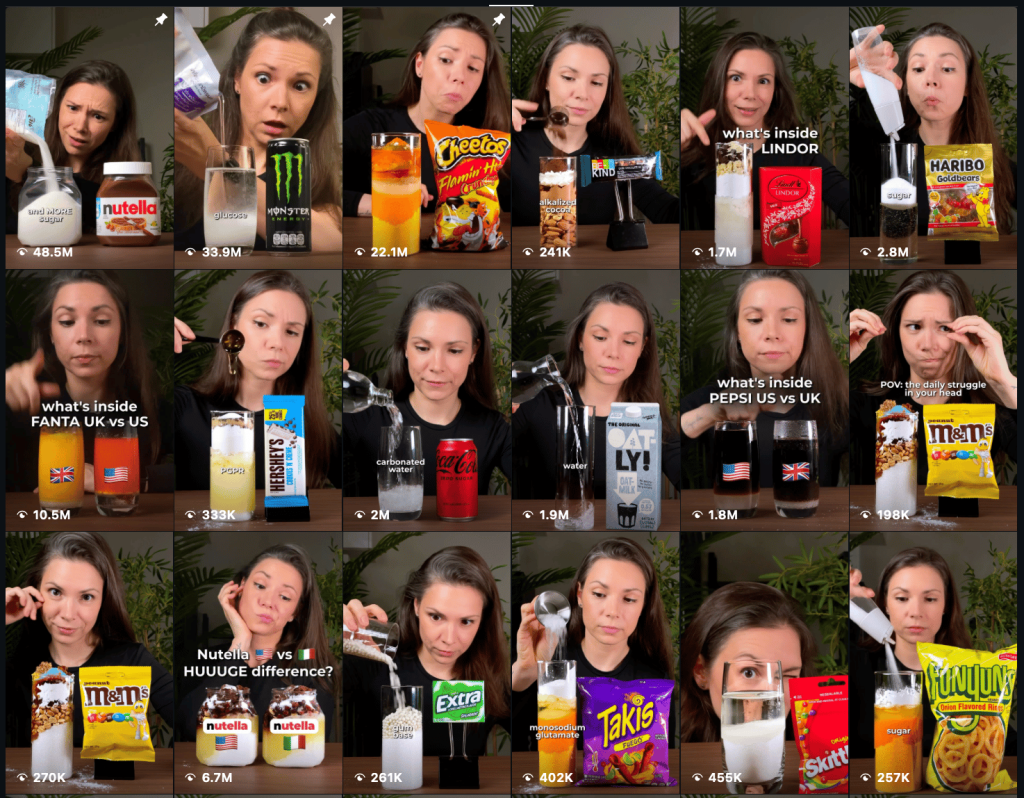
She was one format away on finding her own signature content. And now she can replicate it and every single day. The opportunities are just huge.
And I’ll take the headline apart while I’m at it, because the honest version of this idea isn’t a tactic to get viral. It’s the thing that lets you stop needing to.
Renting versus owning
A trend is a single episode of a show you don’t own. You get a week of borrowed attention, the algorithm moves on, and Friday comes back with the same question: what do I post next week?
Marketers are doom scrolling TikTok and Instagram just to find the next idea, the next template and the next trend that they need to hop on to it. But what if we can change this and make something useful with our time?
I strongly believe that a trend is someone else’s format. A format is your own trend.
Shaan frames the upside as ten times bigger. That’s still growth framing, and growth framing is what got most marketing teams into the Friday problem in the first place. The payoff I’d sell you is smaller and more useful: you never open the platform again asking what to make.
Here’s how you build your own signature.
1. Start with what you can’t fake
What if we reverse engineer the question – instead of asking ourselves “What Would Perform better?” we can ask “What could I still be doing in a year without hating it?”
That’s when the enthusiasm comes along. I started creating content 20 years ago. I had a blog, then I moved to social media, then I started publishing my own podcast, then I built a newsletter, then I started doing short videos and just building content almost every single day. But I love creating content. I love writing articles, newsletters, designing carousels, reading Linkedin post and so on. I could wake up at 5 am just to write an article on an topic I strongly believe it would help somebody.
As Shaan said it – Enthusiasm is the moat.
Not because passion is a strategy, but because a format only pays at episode 50 and nobody fakes their way to episode 50.
Think about this, the first ten episodes run on effort. The next forty run on either genuine interest or quiet resentment, and the audience can tell which.
So the first question isn’t “what would perform.” It’s “what could I still be doing in a year without hating it.”
2. Find the mechanic — one setting, one question, one payoff
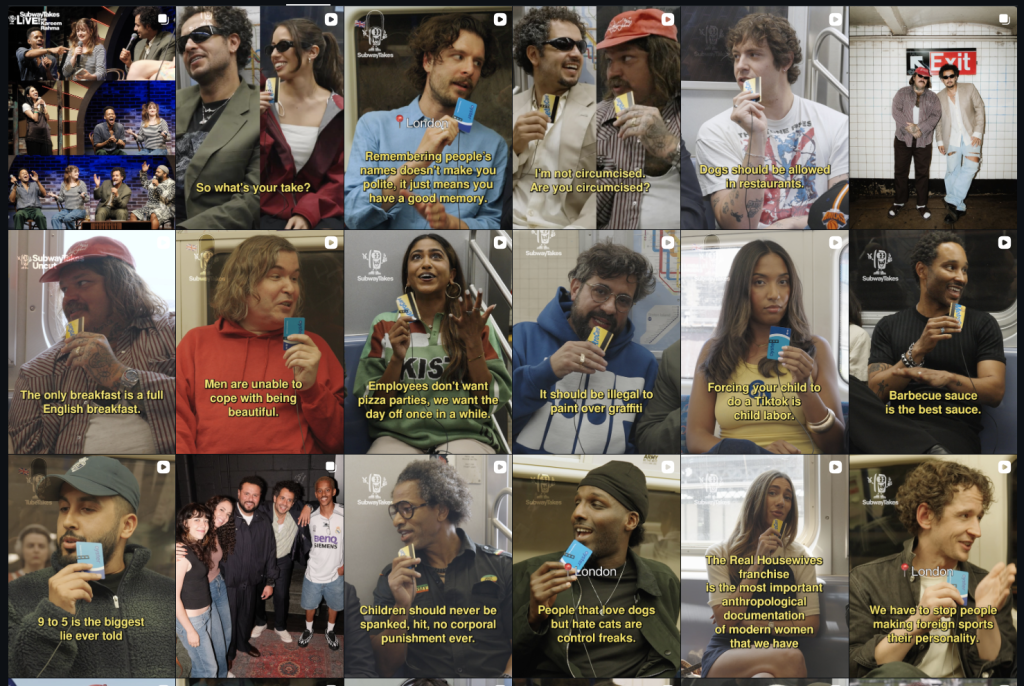
Subway Takes: a subway discussion, two microphones and the first question “So…What’s your take…” then the host agrees or disagrees. A repeatable format that anybody can answer that. And because anybody can answer that is so relatable that people would want to see others take.
Science Snitch: “what’s inside X?”, the ingredient list gets showed in a transparent glass, her reaction is the payoff.
Brooklyn Coffee Shop: a fictional café, one customer archetype per episode, a deadpan barista.
Three parts. That’s the entire machine.
The test I’d use is the one-blank test.
Write your format as a single sentence with exactly one blank in it.
They can easily complete these sentences every single time.
- “What’s inside ___?”
- “People think about, ___.”
- “The customer who ___ walks into the coffee shop.”
If it takes a paragraph to describe, you don’t have a format. If the sentence needs three blanks, you have a content signature, which is a different and much slower thing.
One sentence, one blank.
3. Freeze everything except the variable
This is the part most people skip.
Your signature content should have a repeatable set-up but a changeable subject.
Think about Science Snitch. The setting, the host, the framing, the length, the opening line – all fixed. But she is just changing the subject she is analyzing seeing in what’s inside.
And now, as we discussed, the way we think is reverse engineer – what is non-negotiable and never change: the settings, the host, the frame, the length, the opening line (hook) – this is all fixed. But what can we change around – one thing – one simple thing that can be replicated all over again. Think about the product, the subject or the situation.
The fixed frame is what makes it repeatable. But the single variable is what makes it infinite.
Most brands do the opposite.
They keep the topic constant and reinvent the format every time, then wonder why nothing accumulates.
Reversed, it works: same shape every week, new input.
4. Run it until it becomes your signature
At some point the format stops being content you make and becomes the thing other people copy. Subway Takes has clones now.
But there can be other type of content signatures like @theschoolofhardknockz/ or @maxoklymenko/
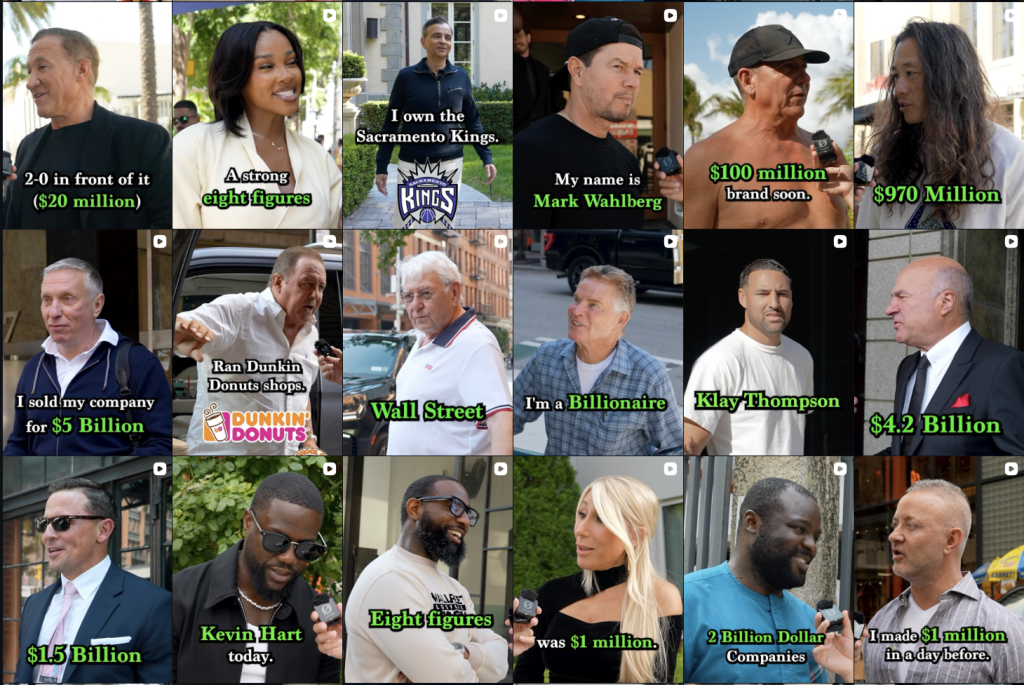
The format is somehow the same – short question, one topic, different people – you can start doing your own format and one day you will see a new clone of your own format. And don’t get mad. Because it will work people will want to copy you.
But guess what? That’s the moment. When other people are making your format, you’re no longer participating in a trend. You’re the thing being trended.
The B2B version is even better
Every example so far is a consumer creator, and if you’re a founder or running marketing inside a company, “rent a subway car” isn’t a line item.
Being the marketer behind the social media accounts you want to blow up is harder then before. Because the competition is even bigger and your audience attention is not so easy to have it.
Yes, there are brands like ClickUp that used the HR Goes Hard format that brought them millions of views on TikTok, Instagram and Linkedin. But now they changed the format and I think they are building the B2B Saturday Night Live shows for Instagram and TikTok and it’s working.
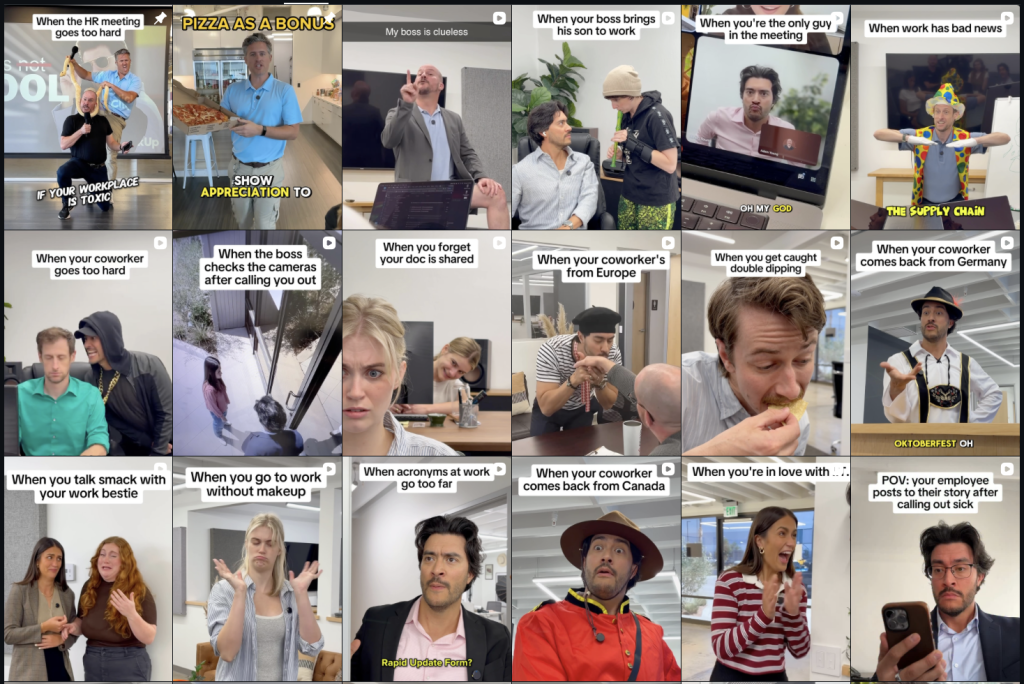
Same office, same recurring characters, one workplace situation per episode. Fixed set, fixed cast, one variable.
Where this sits in slow marketing
The format is the unit of compounding.
The thesis has always been that six months of consistent content beats one viral hit. The format is the mechanism that makes six months survivable.
That’s how you maintain your audience attention – the phase where most brands quit – because maintain attention is exactly where “what do I publish” starts costing more than the post itself.
But it’s also the cleanest example of content signals I know. One thing, repeated, until both people and algorithms know what you stand for.
Which brings the headline back around.
You’re not one format away from going viral.
You’re one format away from not caring whether you do.
So: write yours as one sentence with one blank in it. If you can’t, what you have is a posting habit, and posting habits are what trends feed on.
So let me finish this article with one question – What’s the one thing in your content that changes every week, and what have you refused to change around it?
Leave a Reply